Return to Long-Distance Motorcycle Riding After Four-Level Basivertebral Nerve Ablation for Vertebrogenic Low Back Pain
Clinical Question
Can careful clinical evaluation, combined with MRI demonstration of Modic Type 2 endplate changes, identify patients with chronic vertebrogenic low back pain who may benefit from Basivertebral Nerve Ablation after unsuccessful conservative treatment?
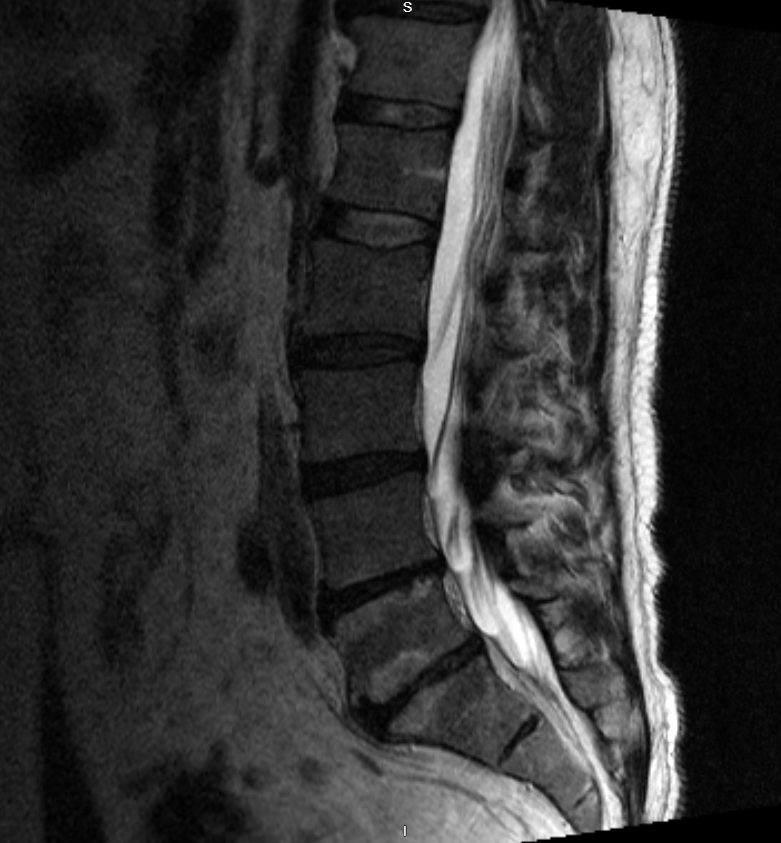 Show labels Enlarge
Sagittal lumbar MRI. Modic Type 2 endplate changes involving the L3, L4, L5, and S1 vertebral levels, interpreted together with the clinical picture to support vertebrogenic pain. De-identified · no PHI.
- Treated vertebral levels
- L3 · L4 · L5 · S1
- #Imaging findings
- 1Modic Type 2 endplate changeL3–L4 endplate
- 2Modic Type 2 endplate changeL4–L5 endplate
- 3Modic Type 2 endplate changeL5–S1 endplate
Reading the Imaging
The MRI is interpreted together with the patient's history, examination, and treatment response.
- Patient Overview
A 75-year-old man presented with more than one year of chronic axial low back pain that progressively limited his daily activities despite prolonged conservative treatment. An avid long-distance motorcycle rider who typically covered many thousands of miles each year, he found that the prolonged sitting his riding required had become increasingly difficult, and the pain had begun to limit an activity central to his quality of life.
Previous treatment included formal physical therapy, activity modification, a home exercise program, oral medications, and interventional pain management including injection therapy. Despite these treatments, his chronic low back pain continued to significantly impact function and quality of life.
- Clinical Evaluation
The patient's history, physical examination, characteristic pain pattern, and unsuccessful response to prolonged conservative treatment raised suspicion for vertebrogenic pain.
Lumbar MRI demonstrated Modic Type 2 endplate changes involving L3, L4, L5, and S1. Interpreted together with the patient's history, physical examination, characteristic pain pattern, and unsuccessful response to prolonged conservative treatment, these findings supported vertebrogenic pain involving the L3, L4, L5, and S1 vertebral levels.
Following comprehensive clinical evaluation, the patient was considered an appropriate candidate for four-level Basivertebral Nerve Ablation.
Fluoroscopic Images of Radiofrequency Ablation Probe Placement
Under fluoroscopic guidance, paired anteroposterior (AP) and lateral images were obtained to confirm radiofrequency ablation (heater) probe position within the vertebral body at each treated level — S1, L5, L4, and L3 — using the Boston Scientific Intracept System.

Anteroposterior (AP) view
S1 vertebral body
Anteroposterior (AP) image demonstrating the Boston Scientific Intracept heater probe positioned within the S1 vertebral body.

Lateral view
S1 vertebral body
Lateral image of the same S1 level, confirming the depth of the Boston Scientific Intracept heater probe within the vertebral body.

Anteroposterior (AP) view
L5 vertebral body
Anteroposterior (AP) image demonstrating the Boston Scientific Intracept heater probe positioned within the L5 vertebral body.

Lateral view
L5 vertebral body
Lateral image of the same L5 level, confirming the depth of the Boston Scientific Intracept heater probe within the vertebral body.

Anteroposterior (AP) view
L4 vertebral body
Anteroposterior (AP) image demonstrating the Boston Scientific Intracept heater probe positioned within the L4 vertebral body.

Lateral view
L4 vertebral body
Lateral image of the same L4 level, confirming the depth of the Boston Scientific Intracept heater probe within the vertebral body.

Anteroposterior (AP) view
L3 vertebral body
Anteroposterior (AP) image demonstrating the Boston Scientific Intracept heater probe positioned within the L3 vertebral body.

Lateral view
L3 vertebral body
Lateral image of the same L3 level, confirming the depth of the Boston Scientific Intracept heater probe within the vertebral body.
The Clinical Course
Improvement following BVNA is frequently progressive; early symptoms are not the final outcome.
- Early Recovery
At the one-week postoperative follow-up, the patient reported approximately 30% improvement in previously described lumbar pain, with early improvement in activity tolerance. Postoperative healing was appropriate, and no procedure-related complications were identified.
The patient was advised that recovery following BVNA is often progressive and that continued improvement is expected during the postoperative healing period.
- Long-Term Outcome
The patient continued to improve steadily over the following several weeks. At the four-week postoperative follow-up, he reported nearly 90% resolution of the chronic axial low back pain that had previously limited his daily activities.
He described substantial improvement in activity tolerance, functional capacity, and overall quality of life compared with the pre-procedure baseline — including a return to the long-distance motorcycle riding that had become difficult before treatment, one of the activities most meaningful to him.
At a Glance
≈90%
resolution of chronic axial low back pain by ~4 weeks
Patient
75-year-old male
Diagnosis
Chronic vertebrogenic low back pain
Prior treatment
More than one year of unsuccessful conservative care
Procedure
Four-level BVNA (L3, L4, L5, S1)
One week
≈30% improvement
Four weeks
≈90% improvement
Clinical Pearl
Successful Basivertebral Nerve Ablation begins with careful patient selection. MRI findings should always be interpreted together with the patient's history, physical examination, characteristic pain pattern, and response to previous conservative treatment. Vertebrogenic pain commonly worsens with prolonged sitting, which can make activities such as long-distance motorcycle riding, driving, and other prolonged seated activities particularly challenging. Modic endplate changes provide important imaging evidence, but the diagnosis of vertebrogenic pain remains a clinical diagnosis supported by the complete patient evaluation.
Continue Your Learning
Continue exploring the educational library at your own pace.
Have similar symptoms?
Every case is individual. A personal evaluation can help determine whether an assessment for vertebrogenic pain may be appropriate for you.