Could Your Chronic Low Back Pain
Be Coming From Inside the Bone?
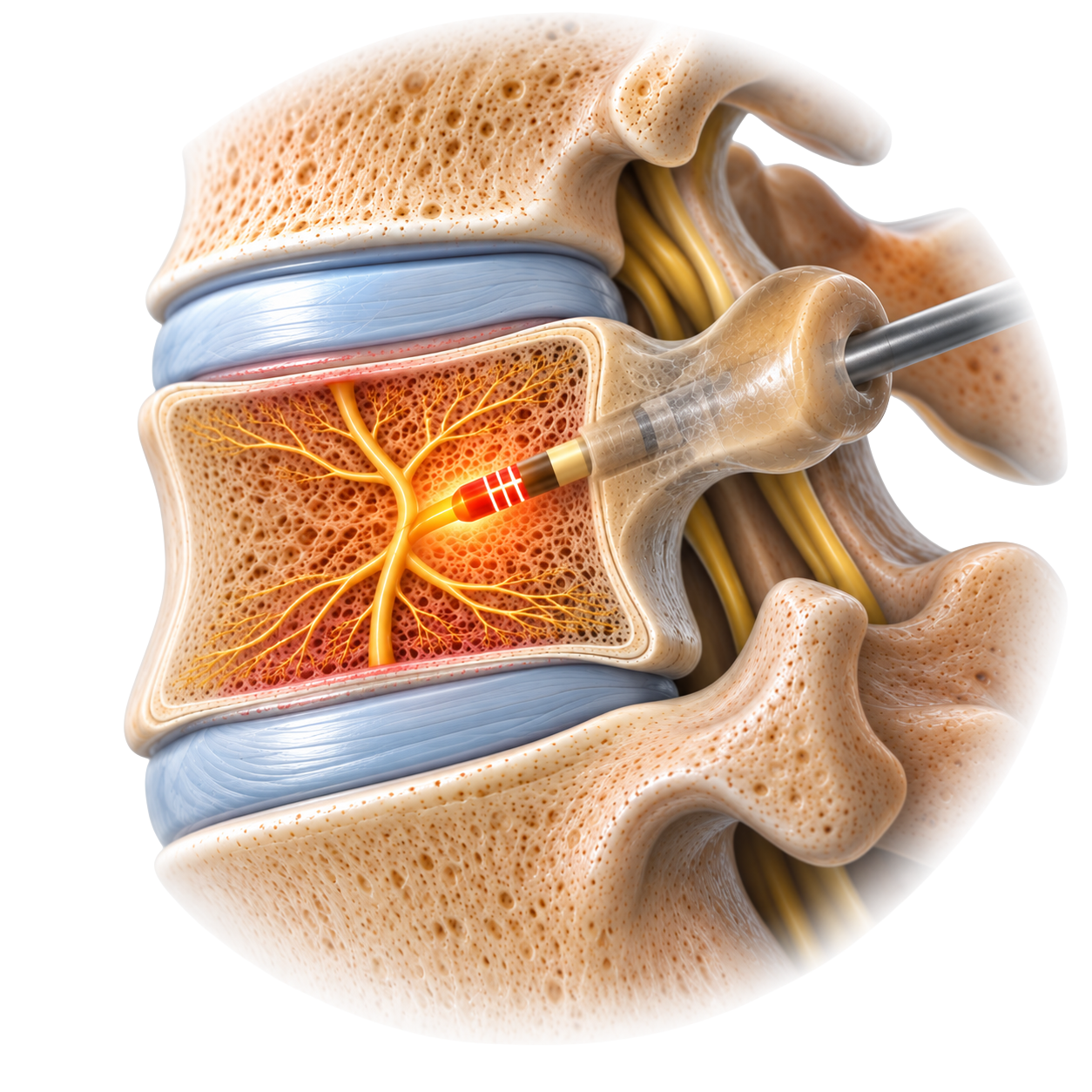
Where the pain may begin
Follow along as a healthy spinal segment changes over time. There is no rush — move at your own pace.
- Step 1 of 7: A healthy segment. The discs of your spine act like shock absorbers, cushioning the vertebrae as you move, bend, and lift.
- Step 2 of 7: The disc dries out. Over time, a disc can lose water content and begin to dry out. Its soft center shrinks, and the cushioning starts to change.
- Step 3 of 7: The disc loses height. As a disc dries out, it can lose height — narrowing the space between the vertebrae and reducing how well it absorbs load.
- Step 4 of 7: The bones get a rougher ride. When the discs lose height and cushioning, the bones can get a rougher ride. The vertebral endplates — the surfaces facing the disc — take on more stress.
- Step 5 of 7: Changes may appear on MRI. In some patients, this irritation may show up on an MRI as Modic endplate changes near the surfaces of the bone.
- Step 6 of 7: The basivertebral nerve. Inside the vertebral body runs the basivertebral nerve. It can carry pain signals from these irritated endplates.
- Step 7 of 7: Pain from inside the bone. In some patients, this nerve may transmit chronic low back pain — pain that can seem to come from inside the bone itself.
What you have been seeing is vertebrogenic pain
Vertebrogenic pain is pain thought to arise from the vertebral endplates and the basivertebral nerve. Clinicians weigh several clues together — symptoms alone cannot diagnose it.
Chronic axial low back pain
Persistent pain centered in the low back, rather than radiating down a leg.
Worse with activity
Pain that may increase with sitting, bending, lifting, or activity.
Modic changes on MRI
Imaging may show Modic Type 1 or Type 2 endplate changes.
Persists despite care
Symptoms that can continue despite a course of conservative treatment.
What is Basivertebral Nerve Ablation (BVNA)?
Basivertebral Nerve Ablation is a minimally invasive procedure designed to interrupt pain signals from the basivertebral nerve in appropriately selected patients. It is considered only after a thorough evaluation.
The basivertebral nerve can carry pain signals from inside the vertebral body.
In appropriately selected patients, a probe is guided toward the nerve.
Treating the nerve pathway may reduce the pain signal it carries.
Think of it like the difference between putting braces on a tooth and treating a cavity. If the pain is coming from the nerve inside the tooth, a dentist would never try to fix it with braces — straightening the tooth cannot reach the problem. A lumbar fusion is like those braces: it can stabilize and align the spine, but it cannot reach the basivertebral nerve inside the vertebra. When degenerative disc disease and Modic endplate changes irritate that nerve, the pain has to be treated at its source — just like a cavity. That is what a basivertebral nerve ablation procedure does — and in appropriately selected patients, clinical studies have shown durable improvements in pain and function extending for years.
Advanced Technologies Used to Perform BVNA
Both are technologies used to perform basivertebral nerve ablation — the procedure is the same.
Intracept System
Boston Scientific
A technology used to perform basivertebral nerve ablation.
- Used to perform BVNA
- Minimally invasive, image-guided approach
OptaBlate BVN System
Stryker
A technology used to perform basivertebral nerve ablation.
- Used to perform BVNA
- Minimally invasive, image-guided approach
The right diagnosis comes before the right procedure
Chronic low back pain is often multifactorial. BVNA may be appropriate when the history, exam, imaging, and prior treatment course together suggest vertebrogenic pain as a meaningful pain generator. Other conditions can also contribute, including:
Facet arthritis
Arthritic changes in the small joints at the back of the spine.
Spinal stenosis
Narrowing of the spaces within the spine.
Sacroiliac pain
Pain involving the joint where the spine meets the pelvis.
Instability
Excess movement between vertebrae in some patients.
Nerve compression
Pressure on a nerve root that can refer pain.
And other factors
A careful evaluation helps identify the most relevant contributors.
A conversation with a physician begins with your full story
A directory listing is a starting point, not an endorsement or an assessment of your condition. Contact an office directly to ask about current services, experience, and availability.
Discuss your history
Your symptoms and previous care matter as much as an MRI finding.
Review the imaging
A clinician can interpret endplate changes in the context of your examination.
Explore options
The next step may or may not be BVNA; an individual evaluation guides the decision.
Could Vertebrogenic Pain Be Part of Your Story?
Understanding your pain is the first step toward choosing the right treatment.