Could My Chronic Low Back Pain Be Vertebrogenic?
Vertebrogenic pain is a type of chronic low back pain that may arise from irritated nerves inside the vertebral body, often associated with changes near the vertebral endplates seen on MRI.
What You'll Learn
Approx. 5–7 min read- What vertebrogenic pain is
- Where it is thought to come from
- How it differs from other kinds of back pain
- What may help identify it
What “Vertebrogenic” Means
The word breaks down simply: “vertebro-” refers to the vertebra, and “-genic” means generated from. Vertebrogenic pain is pain generated from the vertebra itself — specifically, it is thought to arise from the vertebral endplates and the basivertebral nerve inside the bone.
That makes it different from pain coming from a muscle, a joint, or a pinched nerve in the leg. Understanding where the pain may come from is the first step toward understanding why a treatment like BVNA exists.
The Discs Act Like Shock Absorbers
To understand vertebrogenic pain, it helps to see what can change inside the spine over time.
- Step 1 of 4: Discs as shock absorbers. The discs of the spine act like shock absorbers, cushioning the vertebrae as you move.
- Step 2 of 4: The disc dries out. Over time, a disc can lose water content and begin to dry out, changing how it cushions the spine.
- Step 3 of 4: The disc loses height. As a disc dries out, it can lose height — narrowing the space between the vertebrae.
- Step 4 of 4: A rougher ride for the bones. When discs lose height and cushioning, the vertebral endplates may take on more stress — a rougher ride for the bones.
What the Basivertebral Nerve Does
Inside each vertebral body runs the basivertebral nerve. When the endplates become irritated, this nerve can carry pain signals from inside the bone — which is why this kind of pain can feel deep and hard to pinpoint.
- The basivertebral nerve sits inside the vertebral body.
- It can carry pain signals from the irritated endplates.
- This is the nerve pathway that BVNA is designed to address.
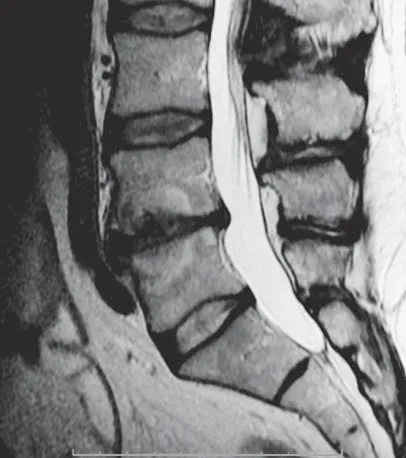
Why MRI Matters
An MRI can sometimes show changes near the vertebral endplates called Modic changes. Modic Type 1 and Type 2 changes are two patterns clinicians may look for.
- Modic changes are one clue a clinician may consider — not proof on their own.
- Many people have imaging changes without the same pain, and vice versa.
- Imaging is interpreted alongside your history, examination, and clinical evaluation.
Clues Clinicians Weigh Together
No single finding is enough. Clinicians look at several clues together — and symptoms alone are not diagnostic.
Chronic axial low back pain
Persistent pain centered in the low back, rather than radiating down a leg.
Worse with activity
Pain that may increase with sitting, bending, lifting, or activity.
Persists despite care
Symptoms that can continue despite a course of conservative treatment.
MRI findings
Imaging that may include Modic Type 1 or Type 2 endplate changes.
Back Pain Is Often Multifactorial
More than one thing can contribute to chronic low back pain. BVNA is considered only when vertebrogenic pain appears to be a meaningful contributor — after other sources have been weighed. Other possible contributors include:
Facet arthritis
Arthritic changes in the small joints at the back of the spine.
Spinal stenosis
Narrowing of the spaces within the spine.
Sacroiliac joint pain
Pain involving the joint where the spine meets the pelvis.
Instability
Excess movement between vertebrae in some patients.
Nerve compression
Pressure on a nerve root that can refer pain.
Muscular pain
Pain arising from the muscles and soft tissues of the back.
How This Connects to BVNA
If a careful evaluation suggests vertebrogenic pain is a meaningful contributor, one option that may be discussed is Basivertebral Nerve Ablation (BVNA) — a minimally invasive procedure that targets the basivertebral nerve pathway in appropriately selected patients.
Continue Your Learning
Keep exploring the educational library at your own pace.
Could Vertebrogenic Pain Be Part of Your Story?
Understanding your pain is the first step toward choosing the right treatment.